Program Design: Blending Classroom, Field and Experiential Learning in Youth Development
Young people today need more than academic knowledge to succeed in an increasingly complex and fast-changing world. While classroom education remains essential, educators and community leaders recognise that personal growth, leadership skills, problem-solving abilities, and real-world experiences are equally important for preparing youth for future challenges and opportunities.
A well-designed youth development program combines multiple learning approaches to create meaningful and lasting outcomes. By integrating classroom instruction with practical field experiences and hands-on activities, these programs help participants connect knowledge with action and develop skills that extend far beyond traditional academic settings.
Many organisations are adopting approaches similar to school wellbeing programs, recognising that learning is most effective when it supports intellectual, emotional, social, and personal growth simultaneously. This holistic perspective helps young people build resilience, confidence, and a stronger sense of purpose.
Understanding the Three Learning Components
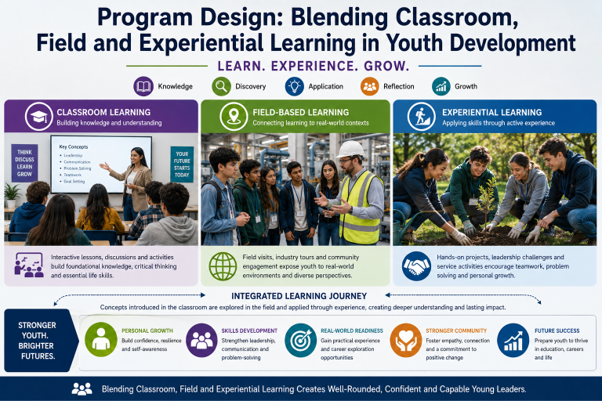
Effective youth development programs often rely on a combination of three complementary learning environments:
- Classroom learning
- Field-based learning
- Experiential learning
Each component serves a unique purpose and contributes to the overall development of participants.
Classroom learning provides foundational knowledge and theoretical understanding. Field learning exposes participants to real-world environments and professional settings. Experiential learning allows young people to apply concepts through active participation and reflection.
When these elements are integrated thoughtfully, they create a richer and more engaging educational experience than any single approach could achieve on its own.
The Value of Classroom Learning
Classroom instruction remains an important foundation for youth development.
Structured learning environments provide opportunities to introduce concepts, explore ideas, and build critical knowledge. Topics may include leadership, communication, goal setting, teamwork, career planning, financial literacy, and personal development.
Classroom sessions allow facilitators to:
- Present key concepts
- Encourage discussion
- Develop critical thinking
- Explore case studies
- Foster collaborative learning
These sessions provide participants with the theoretical framework needed to understand more complex real-world situations. For example, a leadership workshop may introduce communication strategies and decision-making models that participants later apply during field or experiential activities.
Bringing Learning to Life Through Field Experiences
Field-based learning connects participants with real-world environments where they can observe concepts in action.
These experiences may include:
- Workplace visits
- Community projects
- Industry tours
- Environmental programs
- Cultural experiences
- Professional networking events
Field experiences help young people understand how classroom knowledge applies outside traditional educational settings.
A student learning about environmental sustainability, for instance, may gain deeper insight by visiting a conservation project or participating in ecological fieldwork. Similarly, a young person interested in healthcare may benefit from observing professionals in a clinical setting.
Exposure to authentic environments often inspires curiosity and helps participants explore potential career pathways. Many students report that field experiences are among the most memorable and impactful components of youth programs because they provide tangible connections between learning and real life.
The Power of Experiential Learning
Experiential learning focuses on active participation rather than passive observation.
Instead of simply discussing concepts, participants engage directly in activities that require them to apply knowledge, solve problems, and reflect on their experiences.
Examples of experiential learning include:
- Leadership challenges
- Team-building exercises
- Community service projects
- Simulations and role-playing activities
- Outdoor education programs
- Entrepreneurial projects
This approach is based on the idea that people learn most effectively through experience. When young people actively participate in meaningful activities, they develop a deeper understanding of concepts and are more likely to retain what they learn.
Creating Meaningful Connections Between Learning Environments
The true strength of blended program design lies in the integration of different learning methods.
Rather than treating classroom instruction, field experiences, and experiential activities as separate components, effective programs create intentional connections between them.
For example:
- Classroom lessons introduce key concepts.
- Field visits demonstrate those concepts in practice.
- Experiential activities allow participants to apply and reflect on what they have learned.
This sequence reinforces understanding and encourages deeper engagement.
A youth leadership program might begin with workshops on communication, followed by visits to community organisations, and conclude with participants leading their own service projects.
Each stage builds upon the previous one, creating a comprehensive and cohesive learning journey.
Supporting Personal Growth and Self-Discovery
Blended learning approaches are particularly effective for fostering personal development.
As participants move between different learning environments, they encounter new challenges, perspectives, and opportunities for reflection.
These experiences help young people:
- Identify strengths and interests
- Develop self-confidence
- Improve decision-making skills
- Build resilience
- Enhance adaptability
- Strengthen interpersonal skills
Personal growth often occurs when individuals step outside their comfort zones and engage with unfamiliar situations. Field experiences and experiential activities provide valuable opportunities for self-discovery that traditional classroom settings may not always offer.
Encouraging Engagement and Motivation
One challenge faced by many educational programs is maintaining participant engagement.
Blended learning models address this issue by introducing variety and relevance into the learning process.
Young people are often more motivated when they can see how learning connects to their interests, goals, and future opportunities.
Benefits of a blended approach include:
- Increased participation
- Greater enthusiasm for learning
- Improved retention of information
- Stronger sense of purpose
- Enhanced problem-solving abilities
Interactive experiences help transform learning from a passive activity into an active and meaningful journey.
Measuring Impact and Success
Effective youth development programs also incorporate evaluation and reflection to measure outcomes and identify opportunities for improvement.
Assessment methods may include:
- Participant feedback
- Reflection journals
- Skills assessments
- Goal achievement tracking
- Mentor observations
- Community impact measures
Reflection is especially important because it helps participants process their experiences and connect them to future actions. By evaluating both personal growth and program effectiveness, organisations can continuously refine their approaches and maximise positive outcomes.
Preparing Youth for Future Success
The ultimate goal of blended youth development programs is to prepare participants for future success in education, careers, and life.
Through a combination of knowledge, practical experience, and personal growth, young people develop competencies that are increasingly valuable in today’s world.
These competencies include:
- Leadership
- Communication
- Collaboration
- Critical thinking
- Adaptability
- Emotional intelligence
By exposing youth to diverse learning environments, programs help them become more confident, capable, and prepared to navigate future challenges.
Conclusion
Blending classroom, field, and experiential learning creates a powerful framework for youth development. Each learning environment contributes unique benefits, and together they provide a comprehensive approach that supports academic growth, personal development, and real-world readiness.
Classroom instruction builds foundational knowledge, field experiences connect learning to authentic contexts, and experiential activities encourage active participation and reflection. The integration of these approaches helps young people develop the skills, confidence, and resilience needed for future success.
As educators and organisations continue to innovate in youth development, blended program design offers an effective way to engage participants, foster meaningful growth, and prepare the next generation for the opportunities and challenges ahead. When learning extends beyond the classroom and into the real world, its impact becomes deeper, more relevant, and far more lasting.