Key Steps in the Investment Decision Making Process for Equity Funds
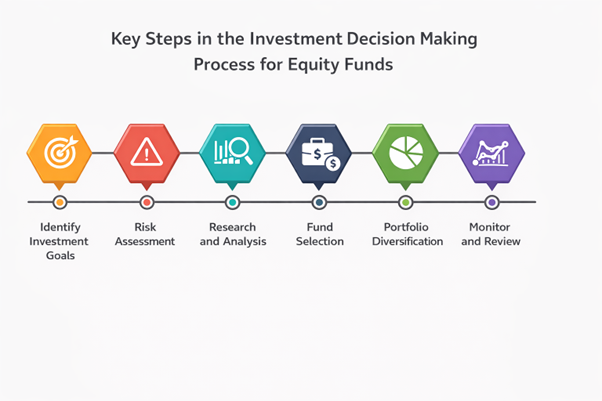
Equity fund investing requires a structured, disciplined, and research-driven approach to generate consistent returns while managing downside risk. We operate within a framework that prioritises clarity, data-backed insights, and long-term value creation. Every decision is guided by a systematic methodology that balances market opportunities with inherent uncertainties.
At the core of this framework lies the investment decision making process, which ensures that each step, from idea generation to portfolio allocation, is executed with precision and accountability. This process is not linear but iterative, evolving continuously as new data, trends, and market signals emerge.
When managing strategies such as a Japan equity fund, we further refine our approach to accommodate regional nuances, sector-specific dynamics, and macroeconomic variables unique to the Japanese market. This enhances our ability to uncover value and maintain a competitive edge.
Step 1: Defining Investment Objectives and Constraints
Every successful equity strategy begins with clearly defined objectives. We establish parameters that guide all subsequent decisions, ensuring alignment with investor expectations and risk tolerance.
These objectives typically include:
- Target return expectations over a defined time horizon
- Acceptable levels of volatility and drawdowns
- Liquidity requirements and capital deployment timelines
In parallel, we identify constraints such as regulatory considerations, market accessibility, and sector exposure limits. This foundational step ensures that the strategy remains focused and consistent throughout its lifecycle.
Step 2: Conducting Macroeconomic and Market Analysis
Understanding the broader economic landscape is essential for making informed investment decisions. We analyse key indicators such as GDP growth, inflation trends, interest rates, and fiscal policies to assess the overall health of the market.
This macroeconomic lens helps us identify:
- Favourable economic cycles for equity investments
- Potential risks arising from policy changes or global events
- Sectoral tailwinds driven by economic shifts
By integrating macro insights into our strategy, we position portfolios to benefit from emerging opportunities while mitigating systemic risks.
Step 3: Sector and Industry Evaluation
Once the macro environment is assessed, we narrow our focus to specific sectors and industries that demonstrate strong growth potential or structural advantages.
We evaluate sectors based on:
- Competitive dynamics and market positioning
- Innovation and technological advancements
- Regulatory support and long-term sustainability
This step allows us to allocate capital strategically across industries that are likely to outperform, ensuring that the portfolio captures both cyclical and secular growth trends.
Step 4: Fundamental Analysis of Companies
At the heart of equity investing lies rigorous company-level analysis. We conduct in-depth research to identify businesses with strong fundamentals and sustainable competitive advantages.
Our evaluation includes:
- Revenue growth consistency and profitability margins
- Balance sheet strength and debt management
- Management quality and corporate governance standards
We also assess qualitative factors such as brand positioning, innovation capabilities, and strategic vision. This holistic approach enables us to distinguish high-quality companies from the broader market.
Step 5: Valuation and Pricing Assessment
Even the strongest companies must be evaluated in terms of their market valuation. We apply a disciplined approach to determine whether a stock is fairly priced, undervalued, or overvalued.
Key valuation metrics include:
- Price-to-earnings (P/E) ratios
- Price-to-book (P/B) ratios
- Discounted cash flow (DCF) analysis
Our objective is to invest in companies where the market price does not fully reflect intrinsic value. This margin of safety is crucial for achieving favourable risk-adjusted returns.
Step 6: Portfolio Construction and Allocation Strategy
Portfolio construction is where individual investment ideas are translated into a cohesive strategy. We focus on building a diversified portfolio that balances risk and return effectively.
Key principles include:
- Diversification across sectors and market capitalisations
- Position sizing based on conviction and risk profile
- Balancing growth-oriented and defensive stocks
This structured allocation ensures that no single investment disproportionately impacts overall performance, while still allowing high-conviction ideas to contribute meaningfully.
Step 7: Risk Management and Monitoring
Risk management is an ongoing process that extends beyond initial investment decisions. We continuously monitor portfolio performance and market conditions to identify potential risks.
Our approach includes:
- Tracking volatility and correlation across holdings
- Assessing exposure to macroeconomic and geopolitical risks
- Implementing stop-loss or rebalancing strategies when necessary
By maintaining a proactive stance, we safeguard the portfolio against unexpected market movements and preserve long-term capital.
Step 8: Performance Evaluation and Continuous Improvement
Evaluating performance is essential for refining our strategy and enhancing future outcomes. We measure returns against benchmarks and analyse deviations to understand underlying drivers.
This involves:
- Attribution analysis to identify sources of return
- Reviewing investment decisions for consistency and accuracy
- Incorporating lessons learned into future strategies
Continuous improvement ensures that our approach remains adaptive and resilient in changing market environments.
Building a Disciplined and Repeatable Investment Framework
A well-defined investment framework is the cornerstone of successful equity fund management. By following a structured process, from setting objectives to ongoing monitoring, we create a system that is both disciplined and adaptable.
This comprehensive approach enables us to navigate complex markets with confidence, identify high-quality investment opportunities, and deliver consistent, long-term value. Through rigorous analysis, strategic allocation, and continuous refinement, we ensure that every investment decision contributes to a cohesive and effective portfolio strategy.